Where Most AI Projects Break and Who Actually Handles It Better
Most AI projects begin with convincing momentum. Strong demos, clear use cases, and fast early wins make everything look under control. This early success creates a dangerous illusion: if it works in a controlled environment, it should work in production. In reality, it almost never does.
Real problems don’t show up at the start. They appear later, when AI meets undocumented legacy systems, rising costs, and shifting requirements. This article looks at where projects actually break under pressure and which companies are better prepared for that stage. The difference between building AI and living with it defines everything that follows.
Where AI Projects Start Breaking in Practice
AI projects rarely collapse all at once. They degrade over time. Once real infrastructure, users, and business constraints come into play, cracks start to show. At first, everything still seems to work, at least in the way demos do. But production quickly exposes weak points. Failure here isn’t random; it’s structural. Early decisions around architecture and integration define whether the system holds up.
Understanding recurring failure patterns matters more than fixing isolated mistakes. They reveal deeper issues in how AI delivery is approached. When the same problems appear across teams and use cases, it points to systemic blind spots. These patterns tell you more than any pitch or case study. The most common points where AI projects start breaking are:
- Weak integration with existing systems and workflows;
- Poor control over model behavior, outputs, and costs;
- AI features that work in demos but fail under real usage;
- Lack of support for iteration once requirements change;
- Engineering gaps between prototype and production.
These failure patterns separate short-term vendors from partners capable of sustaining systems over years, not weeks.
Companies That Handle AI Beyond the Demo Stage
This isn’t a generic “best AI companies” ranking. Market presence, funding, and brand recognition say little about how a company handles post-launch AI. The selection below focuses on something narrower and, frankly, more useful. Each company here demonstrates a particular strength in managing complexity after the initial build: integration depth, long-term product thinking, operational discipline, or the ability to scale without breaking what already works.
1. Geniusee
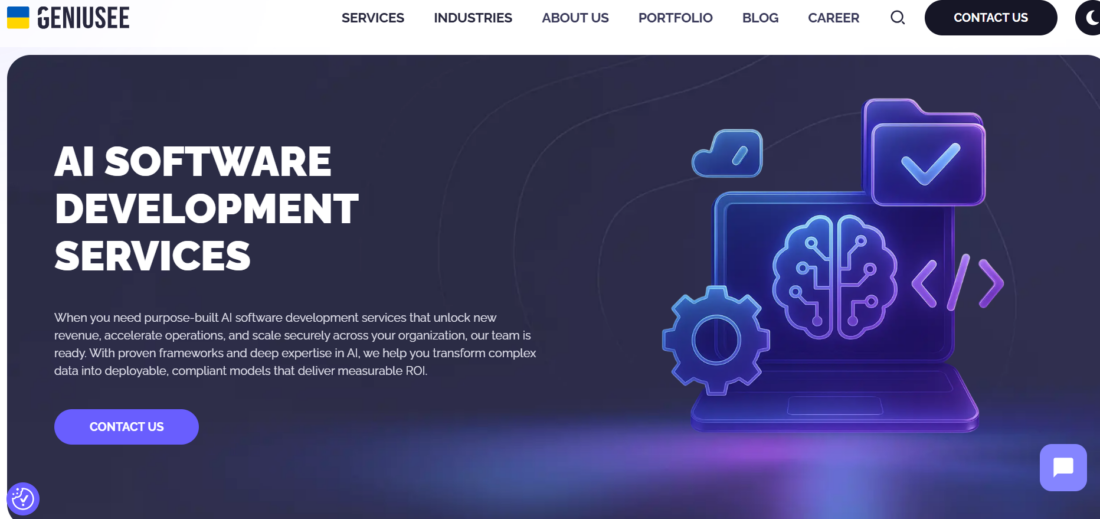
Geniusee works at the point where AI meets real products: web platforms, mobile apps, custom software, cloud, and QA. This matters because most AI failures come from integration, not models. Systems work in isolation but break when connected to legacy databases, existing user flows, or standard DevOps pipelines. Geniusee is built around this reality, covering the full engineering stack needed to keep AI functional in production.
Why It Holds Up After the First Release
Geniusee doesn’t treat AI as a one-off delivery. They build it into systems that are meant to keep running, evolving, and being maintained over time. Instead of separating infrastructure, integration, and support, they handle it as one continuous process. Launch here isn’t the end. It’s the point where real work starts.
Their strengths include:
- Generative AI and AI integration inside existing products;
- Coverage across web, mobile, custom software, QA, and DevOps;
- Practical support for NLP, computer vision, and enterprise AI use cases;
- Ability to support AI systems after launch, not just build them.
This full-stack approach fits teams that need AI to remain stable over time.
2. BairesDev
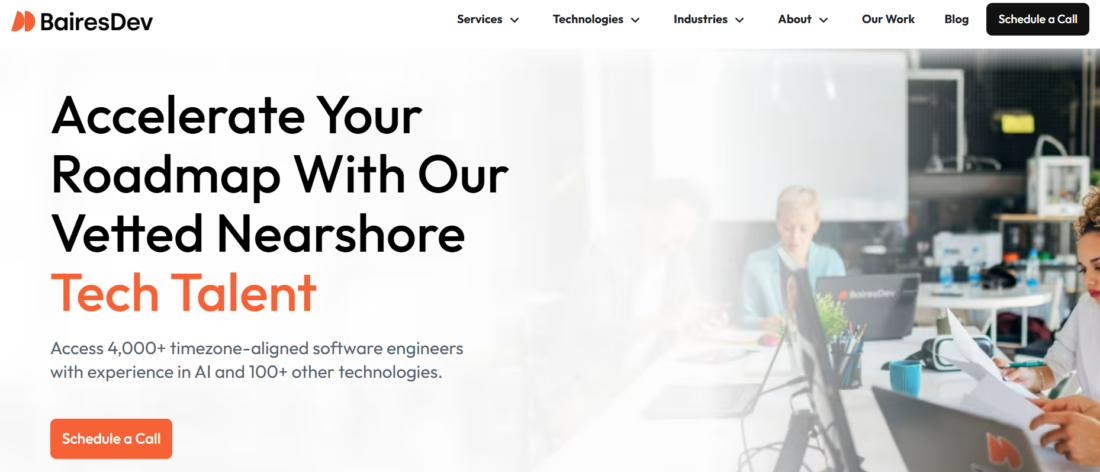
BairesDev brings scale to AI implementation. The company operates as a large engineering partner with enough depth to handle complex initiatives without slowing down on key resources. Their AI work builds on a broader engineering base, including custom development, generative AI integration, and agentic AI systems. For projects expected to grow beyond the initial scope, this scale becomes a structural advantage.
Where Scale Becomes an Advantage
Scale starts to matter once AI moves past the early stage. Initial builds may need a small team, but production systems require more: monitoring, failover, cost control, and coordination across services. Without sufficient capacity, growth turns into instability. BairesDev addresses this with:
- Custom AI development and agentic AI systems;
- Generative AI integration into enterprise products;
- Large engineering capacity for complex delivery;
- Strong fit for scaling AI initiatives.
Projects that anticipate rapid growth or unpredictable usage patterns benefit from this kind of resource depth.
3. Azumo
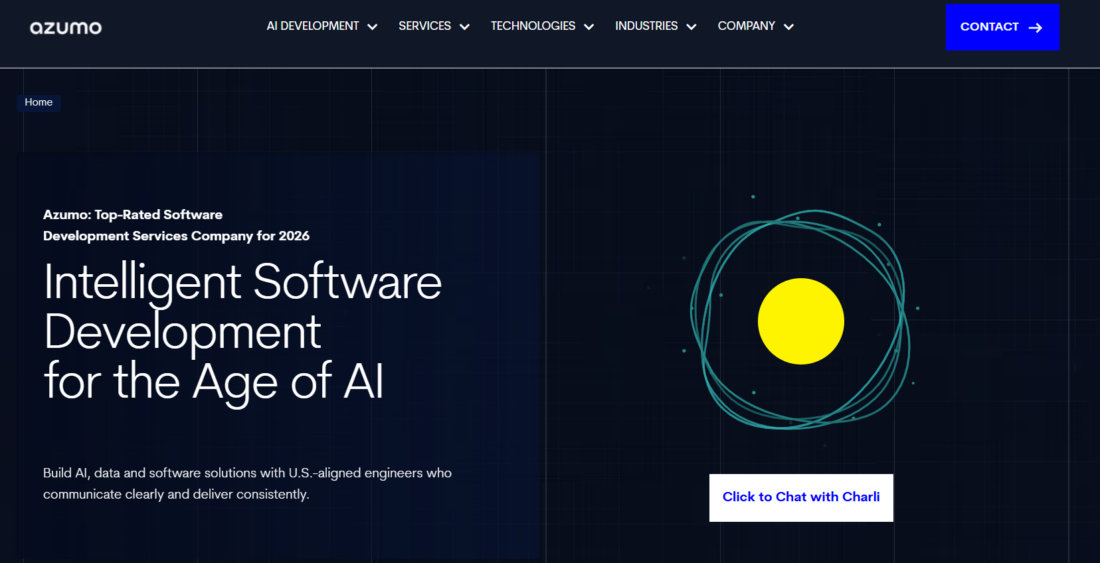
Azumo focuses on practical AI that works inside existing business software. Their approach prioritizes production readiness over experimentation. The company builds LLM applications, NLP solutions, computer vision systems, and AI agents for real automation use cases. The key focus is integration: each solution is designed to fit into systems that already exist and will continue evolving.
Where AI Needs to Work Inside Real Systems
Embedding AI into existing systems brings different challenges than standalone builds. It has to follow existing flows, data structures, and user expectations. Azumo accounts for these constraints from the start, focusing on stability and compatibility instead of chasing the latest models. Their strengths include:
- LLM applications, NLP, and computer vision solutions;
- AI agent development and automation use cases;
- Integration into existing business software;
- Focus on production reliability and deployment.
Companies facing practical integration-heavy use cases will find this mindset more aligned with actual operational needs.
4. Eleks
Eleks works in environments where AI has to fit into existing systems, strict regulations, and infrastructure that can’t be replaced overnight. Their strength isn’t just in models, but in the foundation around them: data engineering, analytics, and large-scale system delivery. Without that, even strong AI solutions stay theoretical and never fully work in production.
Where Enterprise Complexity Starts
Enterprise AI introduces constraints that consumer-facing projects rarely encounter. Compliance requirements shape what data can touch which systems. Legacy infrastructure dictates integration patterns. Large-scale operations demand reliability metrics that demos never consider. Eleks structures their engagements around these realities rather than treating them as afterthoughts:
- Enterprise AI and data-driven solutions;
- Integration into complex business environments;
- Strong focus on data engineering and analytics;
- Suitable for large-scale AI transformation projects.
Organizations navigating heavily regulated or operationally complex environments need partners who recognize that AI success depends as much on surrounding systems as on model performance.
5. EPAM
EPAM brings structured engineering discipline to AI implementation at global scale. Their digital transformation practice includes enterprise AI capabilities, but the differentiator lies in delivery process rather than specific technical tricks. Large AI initiatives fail most often through coordination breakdowns, not technical impossibilities. EPAM’s methodology addresses this directly.
Where Process and Scale Define Success
Large AI programs involve multiple teams, conflicting priorities, and complex coordination. Without structure, this quickly turns into chaos. EPAM approaches AI with the same engineering discipline used in large-scale software: version control, testing, deployment pipelines, and incident response. These practices remain critical even when AI becomes part of the system. Their strengths include:
- Enterprise AI and digital transformation capabilities;
- Strong engineering processes and delivery structure;
- Integration across large systems and teams;
- Suitable for long-term, large-scale AI programs.
Companies running multi-year transformation efforts need partners whose operational maturity matches the program’s complexity.
6. Atomic Object
Atomic Object builds software with a clear product focus, and their AI work follows the same logic. Instead of chasing scale or quick prototypes, they focus on systems that people actually use and can maintain over time. In many cases, this matters more than team size or model complexity. Some problems aren’t about better models; they’re about understanding how users interact with the product.
Where Product Thinking Matters More Than Scale
Not every AI project needs a large team or heavy infrastructure. Some require attention to how features behave in real usage, how systems hold up over time, and how maintenance evolves as requirements change. Atomic Object works closely with client teams and focuses on software that stays clear and usable after launch, not just during demos. This product mindset matters when AI features need to integrate seamlessly rather than dominate the experience:
- Strong product development mindset;
- Focus on usable, maintainable software;
- Close collaboration with client teams;
- Suitable for mid-sized, product-driven AI initiatives.
Teams that prioritize product quality and long-term maintainability over scale will find this approach more relevant.
7. Ciklum
Ciklum positions itself as an enterprise technology partner focused on AI, automation, and system integration. Their approach reflects a key reality: after launch, governance and operational control become critical. Questions around model versions, approvals, and cost allocation start to matter. These factors often determine whether AI systems can hold up in real business environments.
Where Governance and Stability Become Critical
Post-launch AI systems face scrutiny that prototypes never encounter. Finance wants cost attribution. Security wants audit trails. Compliance wants documentation. Operations wants predictable behavior. Ciklum’s enterprise focus means these concerns get addressed during design, not retrofitted after problems emerge. Their structured approach to AI adoption fits organizations where stability carries equal weight to innovation:
- Enterprise AI and intelligent automation;
- Integration with existing business systems;
- Focus on governance and operational stability;
- Strong fit for long-term transformation projects.
Companies operating in regulated industries or complex organizational structures need partners who treat governance as a design requirement, not a nuisance.
What To Compare Before Choosing an AI Partner
The selection process for an AI partner should focus on delivery capability, not presentation quality. Demos reveal what a company wants you to see. Production readiness reveals everything else. Smart evaluators look past the polished narrative and examine how a partner handles integration, iteration, and the inevitable complications that follow launch. When evaluating AI partners, focus on:
- Production readiness beyond proof of concept;
- Integration with existing systems and workflows;
- Ability to support ongoing iteration and change;
- Approach to governance, security, and cost control;
- Long-term engineering support after launch.
These criteria favor partners who solve problems over those who sell promises. The distinction becomes obvious about three months after deployment.
Final Thoughts
AI doesn’t prove itself in demos or early results. It shows later, when the system keeps working under real conditions, costs stay under control, and the team still understands how everything fits together months after launch. That’s the point where most projects either stabilize or start falling apart.
The companies that handle this well don’t treat AI as a separate feature. They build it into real systems from the start and think about what happens after release, not just before it. This is what keeps projects usable over time, not just impressive at the beginning.