
Retail Execution Software Buyer’s Guide: 10 Worth Considering
You’re a CPG brand manager. Your merchandisers photograph shelves in 200 stores each month, your reps capture reorders on paper, and your accounting team reconciles invoices from three different apps. The friction costs you 15% of your field team’s productive hours — and nobody can tell you which SKUs are out of stock until the next quarterly review.
Retail execution software promises to close that gap. The best platforms unify shelf audits, planogram compliance, order capture, and delivery workflows in one system. The worst ones silo merchandising from sales, force you into enterprise-tier pricing, or require six months of implementation before your first rep logs in.
We evaluated 10 platforms against five criteria: workflow unification (does it handle both audits and orders?), SMB accessibility (can a 20-rep team afford it?), geographic coverage, implementation speed, and CPG-specific feature depth. These 10 firms differ in measurable ways:
| Firm | Best for | Founded | Notable specialty |
| SimplyDepo | CPG brands unifying shelf audits, field sales, and DSD in one app | 2022 | Unified retail execution, field sales, and DSD workflows in one mobile app |
| GoSpotCheck | Audit-only teams needing structured workflows and image recognition | 2011 | PhotoWorks AI shelf surveys |
| Repsly | Merchandising teams prioritizing in-store visibility | 2008 | ShelfScan AI image recognition |
| Pepperi | Enterprises needing all-in-one B2B commerce and DSD | 2012 | Trade promotions and route accounting modules |
| SPOTIO | Territory-based field sales teams tracking activity | 2014 | Territory mapping and route optimization |
| B2B Wave | Wholesalers prioritizing online ordering portals | 2013 | Branded storefronts and customer self-serve ordering |
| Zoey | B2B brands centralizing order intake from multiple channels | 2014 | Quote-to-order conversion and AR automation |
| Orders in Seconds | Wholesale distributors focused on order entry and DSD | 2005 | QuickBooks Desktop/Online specialist |
| WizCommerce | Wholesalers modernizing sales with AI-driven workflows | 2020 | AI catalog management and product recommendations |
| Skynamo | International B2B teams needing multi-region support | 2012 | Radar AI module for sales trend analysis |
What Retail Execution Software Does
Retail execution software gives CPG brands and distributors real visibility into in-store performance. Field teams use it to log shelf audits, photograph displays, track product availability, and note promotions in progress.
This information helps the head office understand which products are missing, whether planograms are being followed, and if promotions are delivering results.
You’ll typically find three main categories:
- Audit-only tools: Focused purely on merchandising tasks, compliance, and image recognition.
- Field sales tools: Prioritize order taking, customer relationships, and route planning.
- Unified platforms: Do both audits and orders within the same app.
The biggest challenge for most teams is that they actually need both types of data. When audit and ordering stay in separate systems, it creates manual handoffs, slower reorders, and information that only surfaces weeks later.
How to Choose Retail Execution Software
The first big question is whether the platform can combine shelf audits and order capture. Unified tools save your team from juggling multiple apps, while separate systems create extra work.
Pricing is another key point. Open per-rep pricing tends to suit SMBs best. Hidden quote-based models with large user minimums are usually built for mid-market or enterprise teams.
Don’t overlook geographic reach. US/Canada-focused platforms can struggle with international operations. You’ll want multi-currency and multi-language features if you work across regions.
Also consider how fast you can get it running. Pure audit tools deploy quickly, but all-in-one systems take longer. Finally, make sure the software has strong CPG features and check how long the company has been around.
GoSpotCheck
GoSpotCheck is now part of FORM and serves as a reliable mobile platform for field teams. It brings structure to daily operations while providing real-time visibility.
Since 2011, it has helped teams handle store audits, surveys, photo documentation, and compliance checks across many sites. Its image recognition technology adds real value by analyzing photos for placement accuracy and quality issues.
The platform allows easy customization of task flows. Managers can monitor everything through clear, live dashboards. Companies focused on execution standards and operational visibility frequently rely on it.
Strengths:
- PhotoWorks AI shelf surveys for automated compliance analysis
- Structured audit workflows with real-time manager visibility
- Multi-industry support beyond CPG (hospitality, facilities management)
Weaknesses: Some users mention connectivity issues, and the platform is positioned around field execution/audits rather than order capture, invoicing, or DSD workflows. (G2 and Capterra reviews)
Who Should Still Choose GoSpotCheck
GoSpotCheck is typically adopted by mid-sized and enterprise companies that require scalable audit and task management systems. It is often positioned as an audit and workflow solution rather than a tool for managing order capture, invoicing, or DSD workflows.
SimplyDepo
SimplyDepo is retail execution software designed specifically for CPG brands and distributors. This mobile-first platform combines shelf audits, planogram checks, photo reporting, demos, and visit tracking with order capture, route planning, van sales, and invoicing.
Since launching in 2022, it has focused on solving the usual disconnect where merchandisers and sales reps use different apps. It delivers AI-powered insights that predict demand, identify performance gaps, and improve routes in real time. Everything syncs natively with QuickBooks and Shopify.
Pricing starts at $89/rep/month with flexible month-to-month billing, no setup fees, and a 30-day free trial. Unlike typical tools that only handle audits or orders, SimplyDepo lets the same person complete the full workflow — from shelf check to reorder to invoice — in one app.
Key Features:
- B2B Order Management
- Retail Execution
- Route Planning
- Field Sales CRM
- QuickBooks Integration
- Shelf Photo Logging
Weakness: Limited to the US and Canada — not designed for multi-region, multi-currency, or multi-language deployments across EMEA or APAC.
Who Should Still Choose SimplyDepo
SimplyDepo is ideal for US and Canada-based SMB and mid-market CPG brands with in-store visits. Teams that need unified audits, orders, and delivery benefit most. The platform replaces multiple disconnected tools with one mobile workflow, without enterprise pricing or long setup times.
Repsly
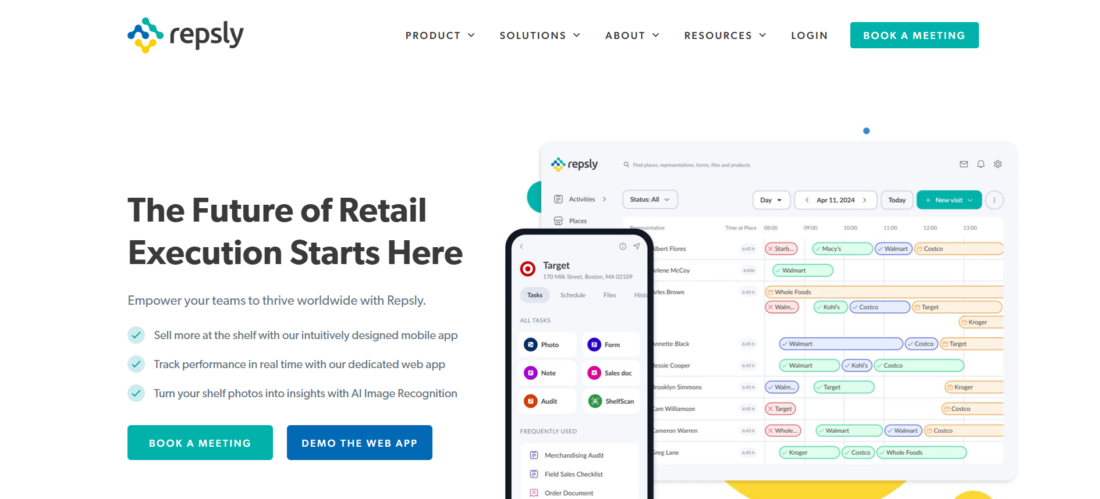
Repsly is a solid retail execution tool designed for CPG brands and merchandising teams. It delivers visibility into store-level execution and helps coordinate field activities.
Founded back in 2008, it includes visit tracking, territory management, and task assignment features. Teams rely on it for shelf audits, planogram compliance, availability checks, and competitor monitoring. It also supports smoother promotion execution across locations.
Its AI image recognition stands out — it analyzes photos to identify products and track compliance, saving time and increasing accuracy. Managers get helpful real-time dashboards to monitor progress.
Weakness: Users report that back-office functions can feel clunky and poorly organized, along with occasional app logouts, stability problems, and usability issues in certain workflows. (G2 reviews)
Who Should Still Choose Repsly
Repsly is typically used by mid-sized to large CPG companies and retail service organizations that prioritize in-store visibility and audit accuracy over integrated sales and distribution workflows.
Pepperi
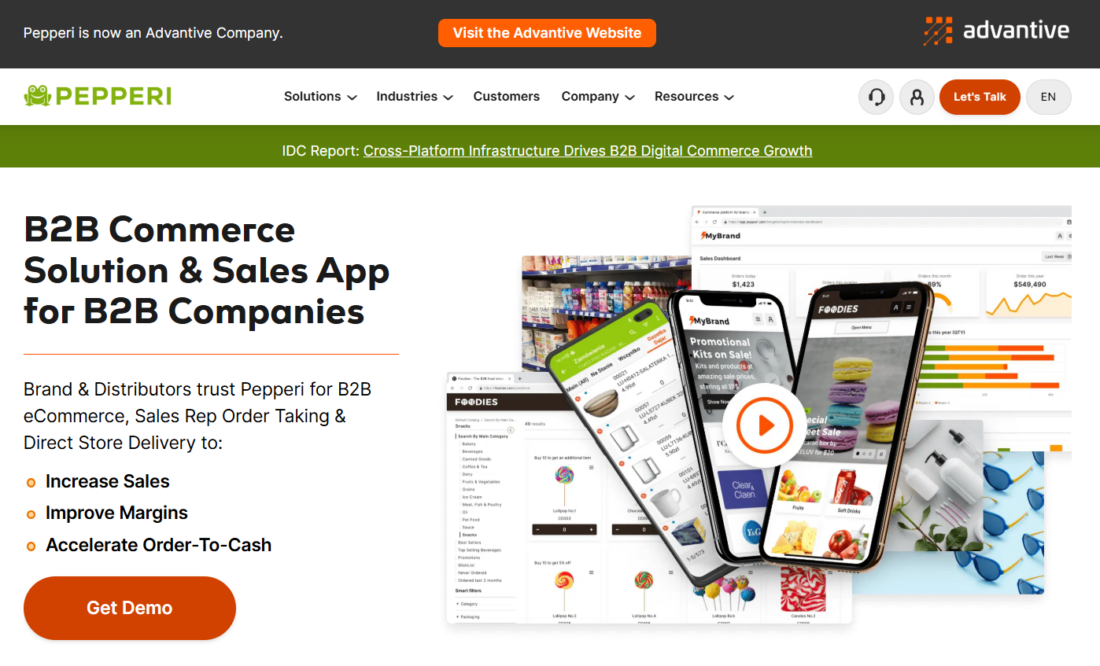
Pepperi is a unified platform for B2B commerce aimed at brands and wholesale distributors. It brings eCommerce, field sales, and distribution tools together.
Launched in 2012, the system lets customers order online through branded portals while giving sales reps mobile tools to capture orders in the field. It also supports direct store delivery, route accounting, trade promotions, and mobile CRM.
This allows companies to manage everything from customer interaction to invoicing in one place. Pepperi integrates well with other software and serves various industries, including FMCG, food and beverage, and health & beauty.
Pros:
- The platform includes retail execution features, such as in-store activity tracking and merchandising support
- Full-stack commerce suite covering eCommerce, field sales, and DSD
- Pepperi integrates with third-party systems and supports a wide range of industries
Cons: Users report higher costs compared to SMB-focused tools, along with the need for setup support or partner involvement, and some mention customer support and billing issues. (Capterra reviews)
Who Should Still Choose Pepperi
Pepperi is typically used by mid-sized and enterprise companies that require a scalable, all-in-one B2B commerce solution. Teams that need trade promotions, multi-channel eCommerce, and retail execution in one platform — and have the budget and timeline for an enterprise implementation — will find it comprehensive.
B2B Wave
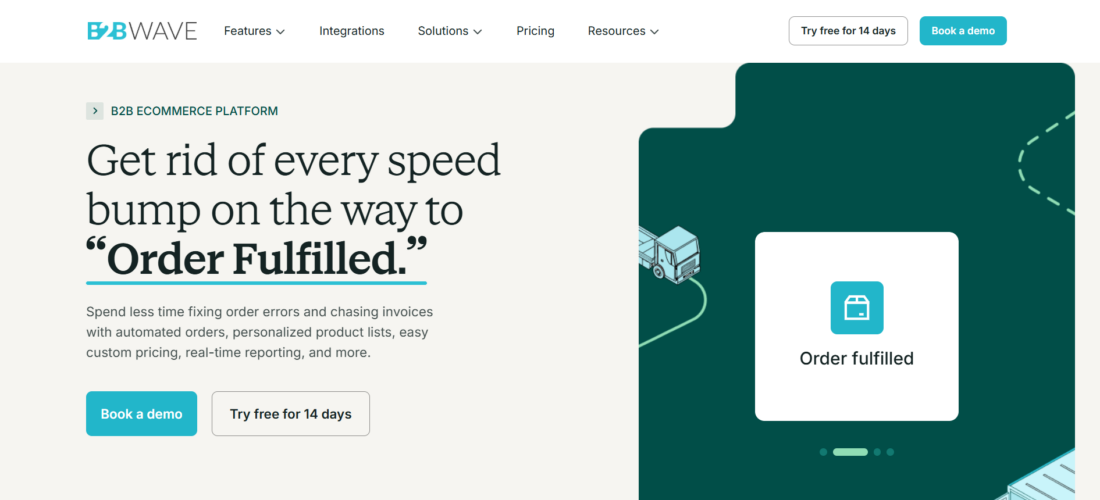
B2B Wave serves wholesale distributors, manufacturers, and suppliers with a focused B2B eCommerce platform. It handles online ordering, pricing, and customer data together.
Founded in 2013, the branded storefront lets customers browse, see their prices, and order independently. It simplifies operations with inventory tracking, order history, and custom pricing.
Reporting features give visibility into sales and stock, while integrations with QuickBooks, Xero, Stripe, and ShipStation keep data consistent.
| Strength | Detail |
| Branded storefronts | Customer self-serve ordering portals |
| Custom pricing | Multiple price tiers per customer segment |
| Order management | Automated order processing and tracking |
| Integration support | QuickBooks, Xero, Stripe, ShipStation |
Weakness: Users report limited advanced reporting and analytics, along with restricted third-party integrations and data syncing. Some also mention basic customization for the customer portal and inefficiencies when handling large catalogs or bulk actions. (G2 reviews)
Who Should Still Choose B2B Wave
B2B Wave is best suited for small to mid-sized wholesalers that want a simple and accessible B2B eCommerce solution. Businesses that prioritize online ordering, custom pricing, and customer portals will find it effective.
It is a good option for companies that operate primarily through digital channels and do not require field sales, retail audits, or DSD workflows.
Zoey
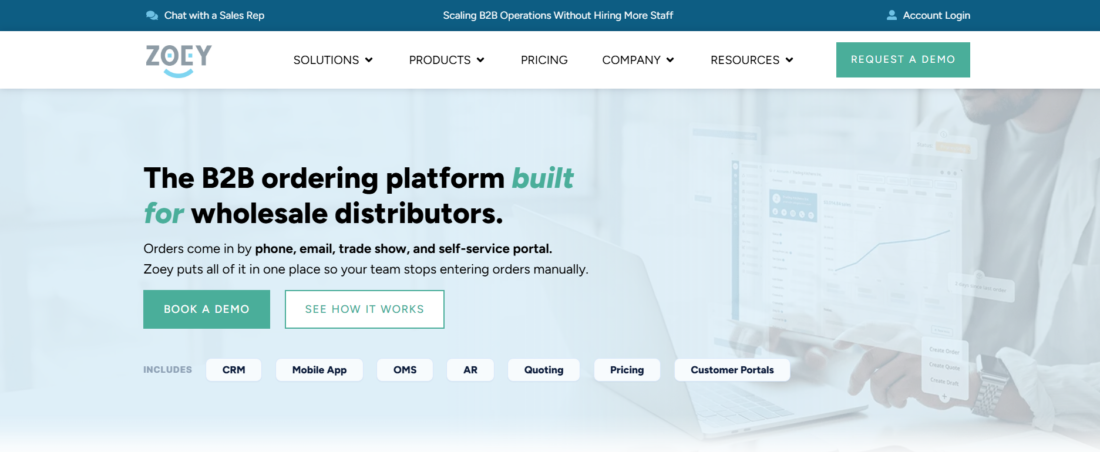
Zoey helps wholesale distributors, manufacturers, and B2B brands manage their eCommerce and orders in one place. It’s especially good at collecting orders from all directions — field sales reps, customer portals, phone, and email.
Founded back in 2014, it comes with a self-service customer portal where buyers can browse pricing, reorder familiar products, and check out independently. Sales teams have access to quoting tools, order capture, and customer management through both mobile and desktop apps.
The platform brings together CRM, order management, invoicing, and accounts receivable features. It supports everyday workflows like converting quotes to orders, handling split shipments, and automating billing. This cuts down on manual entry and extra work. Reliable integrations with NetSuite, QuickBooks, and ShipStation ensure your data stays accurate and up to date across systems.
Strengths:
- Quote-to-order conversion and AR automation
- Multi-channel order intake (reps, portals, phone, email)
- Strong ERP and accounting integrations
Weaknesses: Users report slow or delayed customer support response times, along with limited access to real-time assistance. Some also note that reliance on email-based support can delay issue resolution. (G2/Capterra reviews)
Who Should Still Choose Zoey
Zoey is a good choice for wholesale businesses that want to centralize order intake and enable customer self-service. Companies that rely on B2B eCommerce portals, quoting, invoicing, and account management will benefit from its functionality.
It is particularly useful for teams that want to reduce manual order entry and improve back-office efficiency without focusing on field execution.
Orders in Seconds (OIS)
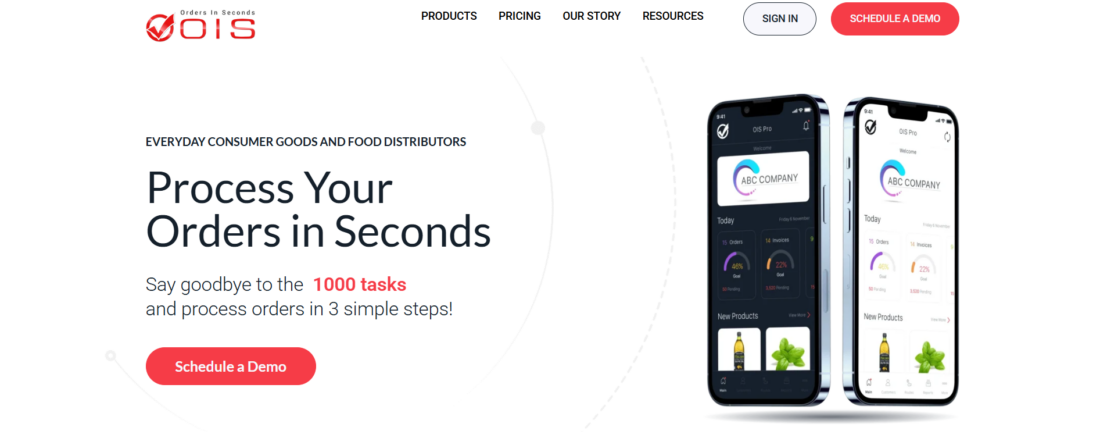
Orders in Seconds (OIS) is a B2B mobile sales and order management platform created for wholesale distributors in the consumer goods and food industries.
Since 2005, it has helped field teams capture orders quickly with real-time inventory access. The system also lets customers order directly via a clean web and mobile storefront.
On top of that, OIS includes warehouse management, stock control, route planning, and delivery tools. This combination helps distributors move from order to fulfillment with fewer headaches and lower costs.
Weakness: While it supports field sales workflows, it does not include dedicated retail execution capabilities such as shelf audits, planogram compliance, or in-store merchandising. (OIS website)
Who Should Still Choose Orders in Seconds (OIS)
OIS fits wholesale distributors needing order entry, inventory visibility, and delivery management. Best for DSD operations or field sales teams focused on order fulfillment. Prioritize order accuracy and delivery efficiency over in-store execution.
WizCommerce
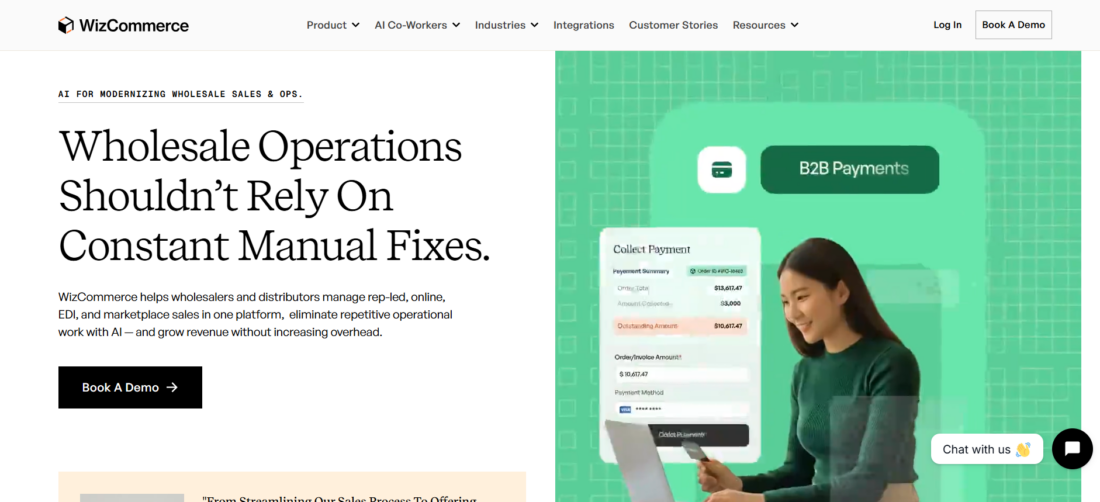
WizCommerce is an AI-powered platform built for wholesalers, distributors, and manufacturers who need better control over both online and field sales.
Since 2020, it has combined a B2B eCommerce storefront with mobile tools for sales reps. Reps can take orders, create quotes, and handle customer interactions on the go, while the system manages payments and orders from various channels.
AI features help automate quote generation, product recommendations, and follow-up reminders. This cuts down on routine work and makes sales teams more effective. The platform also provides AI-assisted catalogs, smart search, and real-time visibility into inventory and customer behavior.
Pros:
- AI catalog management and product recommendations
- Multi-channel order processing (eCommerce, reps, marketplaces, EDI)
- Embedded payment capabilities
Cons: Users list some weaknesses around the learning curve, inaccuracy, complex implementation, accuracy issues, and access issues. It is not positioned for shelf audits, merchandising, or retail execution. (G2 reviews)
Who Should Still Choose WizCommerce
WizCommerce fits wholesalers modernizing sales with AI. Best for online ordering, rep-assisted sales, and automated quotes. Suited for digital B2B commerce, not in-store execution or merchandising.
Skynamo
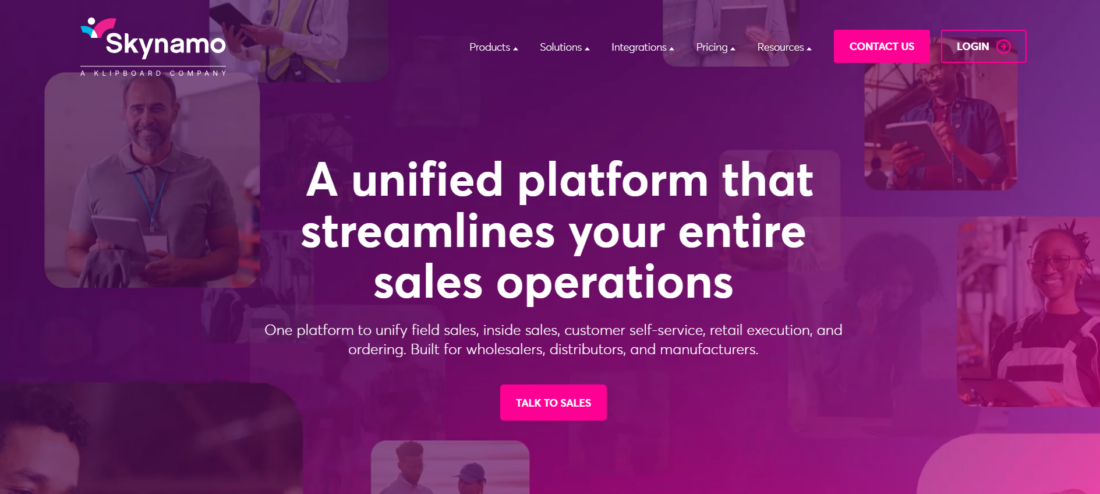
Skynamo serves manufacturers, wholesalers, distributors, and importers with a focused field sales and B2B operations platform.
Since 2012, the platform has offered a mobile app for reps to manage visits, access catalogs, and take orders on-site. Customers can order independently through a branded B2B portal, and inside sales teams have their own tools too.
It also provides useful reporting and AI-powered insights via the Radar module to uncover trends. This helps unify field sales, internal teams, and online ordering into a more connected workflow.
| Feature | Focus |
| Multi-region support | Multi-currency, multi-language |
| Radar AI module | Sales trend analysis and insights |
| Field sales | Visit logging and offline-first order capture |
| Customer portal | Self-service B2B ordering |
Weakness: Limited retail execution — stronger for sales operations than dedicated shelf audits or merchandising workflows. (G2 and Capterra reviews)
Who Should Still Choose Skynamo
Skynamo excels with international B2B operations.
It’s ideal for manufacturers, wholesalers, and distributors looking for capable field sales tools, straightforward order capture, and an easy customer ordering portal.
Non-North American companies needing multi-region and multi-currency features — but not deep retail execution capabilities — tend to get the most value from it.
FAQ
Q: How much does retail execution software cost?
A: It varies. Smaller businesses can start affordably with SimplyDepo at $89 per rep monthly. Enterprise tools usually require custom quotes, and full-featured platforms cost more depending on users and modules.
Q: Does any platform combine shelf audits with order capture?
A: Yes, but it’s not common. SimplyDepo is one of the few that brings both together. Most tools specialize in either audits or orders.
Q: What’s the typical implementation time?
A: Simpler platforms can be ready in days or weeks. Complex enterprise systems often need months of setup.
Q: Do merchandisers and sales reps need different tools?
A: Not necessarily. If you want audit data to drive immediate reorders, a unified solution usually works better.
Q: Which platforms support international use?
A: Skynamo performs well in multiple regions. Pepperi also offers good multi-country support, while SimplyDepo is best suited for North America.
Conclusion
We compared 10 platforms, looking at five important factors: whether they combine audits and orders, how accessible they are for smaller businesses, international capabilities, how fast they can be implemented, and their depth in CPG features.
Field teams in CPG often lose 15% of their time dealing with fragmented data. Strong retail execution tools solve this by connecting shelf audits directly to order capture and the rest of the order-to-cash cycle.
Not every platform is the same. Take a moment to speak with vendors and carefully check that the features match your specific needs — especially planogram compliance and AI shelf tools.